Today is Carlin Sunday. The fifth Sunday of Lent and a day that has been observed across the North East of England for hundreds of years. If you’ve never heard of it, you’re not alone. This is one of those traditions that has been carried mostly in family kitchens, on pub bars, and in local memory rather than in history books. But it deserves a moment in the spring sunlight. Because behind this small, unremarkable-looking brown pea, there’s a story of survival, community, and the kind of everyday food that holds a place together.
Here at Wild Wood Growers, we believe in the power of heritage food – not just for nostalgia, but because growing and eating what belongs to a place is one of the most grounding things you can do. So let’s talk about carlin peas: where they come from, how to grow them, and how to eat them.
Where Does Carlin Sunday Come From?
The true origin of Carlin Sunday is, as with so many folk traditions, a little blurry around the edges. There are several stories, and each region of the North tends to favour its own version.
The most commonly told tale ties the tradition to 1644, when Royalist Newcastle was under siege from Scottish forces during the English Civil War. The city’s food supplies were dwindling when a ship, French or Norwegian, depending on who’s telling the story, broke through the blockade and delivered a cargo of dried peas. The people were fed. And every year after that, so the story goes, they ate carlins in gratitude.
An earlier version points to 1327 and the siege of the port by Robert the Bruce, with a shipload of peas once again arriving in the nick of time. Another tale tells of a ship running aground off South Shields during Lent, with the peas washing ashore to feed hungry locals. Some historians have even linked the name ‘carlin’ to an ancient shipbuilding term, the carling, which is the structural beam of a vessel and which would fit neatly with the shipwreck stories.
There’s also a much older thread. Some food historians point to Roman and pre-Christian traditions of distributing pulses as part of funeral rites and Lenten fasting practices. The earliest written mention of ‘carlines’ as a specific pea variety dates to 1562, in a herbal written by William Turner, who notes them as a distinctly Northumbrian food.
Whatever the true origin, the tradition took root. A northern saying developed over centuries to help people remember the Sundays of Lent leading up to Easter:
Tid, Mid, Miseray, Carlin, Palm, Pace-Egg Day.
Carlin was the fifth Sunday. It sat in the rhythm of Lent like a landmark, a day to cook something simple, share it with neighbours, and mark the slow approach of spring.
The Carlin Pea: A Growing Profile
Carlin peas go by many names: maple peas, pigeon peas, black badgers, and parched peas. They are a heritage field pea, distinct from the sweet garden pea you’d shell fresh in summer, and closer to what has kept people alive through long winters for generations.
The peas themselves are small, round, and a mottled brown colour when dried. When fresh, they’re green, like any other pea. They have a nutty, earthy, slightly sweet flavour and are richer and more complex than a standard garden pea, with a texture somewhere between a lentil and a chickpea once cooked.
At a Glance
- Type: Heritage field pea, grown as a drying pea
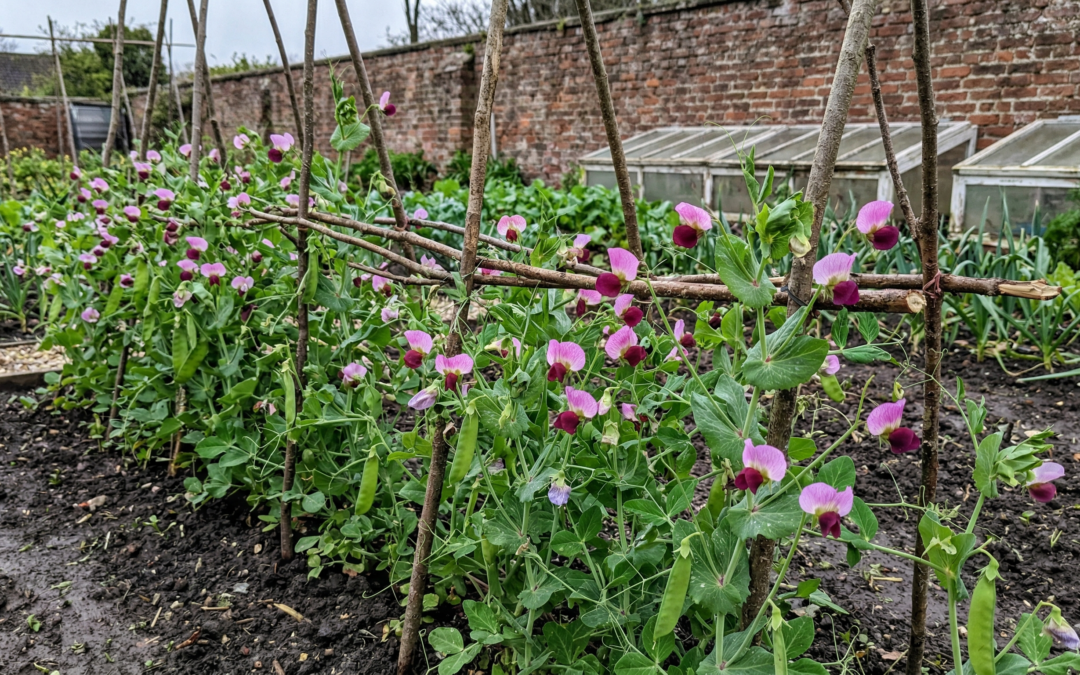
- Habit: Climbing annual with tendrils; reaches 50–90cm tall, sometimes taller in good conditions
- Flowers: Beautiful pink and bicolour blooms — worth growing for the flowers alone
- Pods: Grey-green pods, harvested when the peas are fully mature and beginning to dry
- Seeds: Small, round, mottled brown when dried; green when fresh
- Difficulty: Easy — one of the most forgiving crops you can sow
How to Grow Carlin Peas
Carlin peas are a lovely crop for UK growers because they suit our cool, damp climate well and don’t demand much in return.
Sowing
Sow from March to May. You can start in modules under cover in March and transplant outside in mid to late April, which gives young plants a little protection in exposed spots. Or sow directly into the ground from April onwards when the soil has warmed a little. June is also a possibility for a later harvest.
Soil and site
They prefer a sunny spot with well-drained but moisture-retentive soil. A rich, loamy soil is ideal. Peas fix nitrogen from the air through their roots, which means they actually improve the soil for whatever you plant next, making them an excellent choice in a crop rotation.
Support
They produce plenty of tendrils and are good at supporting themselves, but a few pea sticks or long twigs pushed into the ground alongside the plants will help them climb. Traditional pea sticks are one of the loveliest bits of old kitchen garden kit. They can grow to between 5-6 feet on average, sometimes taller, so additional support may be helpful as the growing season progresses.
Harvesting
For dried carlin peas, leave the pods on the plant until they are fully mature and starting to turn papery. If the weather turns wet before they’ve dried on the vine, pull up the whole plant and hang it somewhere airy to finish drying. Shell the peas when the pods are crackly dry, and store in a cool, dark place in a jar or paper bag.
Saving seeds
The beauty of carlin peas is that your harvest is your seed bank. Set aside a handful of the best, fully dried peas from a healthy plant, label them, and you have next year’s sowing and perhaps some to share. This is exactly what seed saving is all about: keeping varieties alive by growing them, year after year.
Things to watch out for
Pigeons love peas. Mice will eat newly sown seeds if they find them. Aphids can be a nuisance in warm spells. Net young plants if birds are a problem, and sow a little deeper to deter mice. Old CDs hung on the supports are surprisingly effective bird deterrents.
How Carlin Sunday Has Been Celebrated Over the Years
For much of the nineteenth and early twentieth centuries, Carlin Sunday was a genuinely observed occasion across the North East, parts of Cumbria, Lancashire, and of course, Yorkshire! Pubs would put bowls of carlins on the bar for their regulars, free, a gesture of community, often served alongside a sprinkle of salt and vinegar or a splash of rum. It was the kind of food that required nothing fancy, just peas, soaked overnight, cooked simply, and shared.
At fairs and markets, carlins were sold from stalls as a hot street food. In industrial towns, they were a staple takeaway. Food historian Roy Shipperbottom, writing in 1995, recalled ‘black peas’ being a regular fixture at fairs in Lancashire, served from dedicated stalls alongside the other entertainments of the day.
The tradition has declined significantly over the last few decades. Many people in the North East today have never heard of it, let alone eaten carlins. But it hasn’t completely disappeared. Beamish Museum marks the day every year, displaying carlins in their 1900s Co-op grocery as they would have been sold a century ago, and cooking them for visitors. Heritage seed suppliers like Hodmedod’s and Seeds of Scotland stock carlin peas and have played an important role in keeping the variety alive.
There’s something so endearing about the fact that this tradition was carried not by institutions or grand events, but by families and the knowledge passed down in kitchens, the habit of soaking peas on Saturday night, the familiar taste of a dish that arrives once a year and then disappears again.
How to Eat Carlins: Simple Serving Suggestions
The beauty of carlin peas is in their simplicity. They don’t need much. The traditional method is easy, and the variations are endless. Here’s how to get started.
The Traditional Method
- Soak the dried carlin peas overnight in cold water
- Drain and rinse them the next morning
- Boil in fresh water until tender — this usually takes 45 minutes to an hour, depending on how long they’ve been soaked. Do not add salt until they’re fully cooked, as salt during cooking can prevent them softening properly
- Drain and serve
Serving Ideas
The classic: salt, pepper, and malt vinegar.
Serve hot in a bowl. Add a generous pinch of salt, some black pepper, and a good splash of malt vinegar. That’s it. It’s the North East pub version, and it’s super satisfying.
The sweet version: butter, brown sugar, and rum.
Fry the boiled peas in a little butter, add a spoonful of brown sugar, and finish with a splash of dark rum. Serve hot. It sounds unusual but it’s rich, warming, and genuinely lovely on a March evening.
Cold with vinegar.
Cooked carlins can be eaten cold, dressed with salt, pepper, and vinegar, like a simple pulse salad. Good on top of a chunky slice of sourdough toast with a dollop of mustard, or with some good cheese.
In a soup or stew.
Carlins work beautifully in a thick, wintery soup with root vegetables, onion, and a bay leaf or two. They hold their shape better than split peas and add a lovely depth of flavour. A ham hock is the traditional companion, but they’re equally good in a simple vegetable broth.
With a ham bone.
Cook the soaked carlins with a ham joint to allow the peas to absorb the smoky, savoury flavour beautifully. Shred the ham, stir it back through the peas, season well, and serve with crusty bread. Proper Northern comfort food.
In a curry or dhal.
Carlins have enough character to hold up to spice. Use them in place of chickpeas in a simple tomato-based curry, or cook them down slowly with cumin, turmeric, and a little coconut milk for something closer to a dhal. They’re versatile in ways that might surprise you.
Keep the Tradition Growing
The best thing you can do for Carlin Sunday is simple: find some carlin peas, cook them tonight, and tell someone about them. If you’d like to grow your own, they’re straightforward to sow from round about now onwards, and when you harvest and save your own seed at the end of summer, you become part of a very long chain of people keeping this variety alive.
Here at Wild Wood Growers, we love the idea of heritage crops like this finding their way back into North East kitchens. There’s real value in growing and eating what belongs to where you live, not just as a performance of tradition, but as a genuine connection to place and community.
This year feels particularly special for me. It’s a personal tradition to sow the season’s carlin peas on Carlin Sunday itself, a small ritual that ties the cooking to the growing in a way that feels good. But this year, the seeds going into the ground are saved seeds from last year’s crop, grown as part of the Seed Sovereignty’s year-long seed production training programme that I participated in last year. These aren’t peas bought from a packet; they’ve been selected, grown with intention, harvested carefully, and stored through winter. Sowing them today, on Carlin Sunday, feels like closing a loop.
Happy Carlin Sunday. We hope your peas are good.